
Strong backlink metrics and an established history can make an expired crypto domain look like a valuable opportunity, but those signals don’t always tell the full story. A domain may have been used for spam, phishing, or manipulative SEO practices, leaving behind risks long after it expires. Without a thorough review, you could inherit problems that affect future rankings and credibility.
This guide explains how to run a comprehensive spam check on an expired crypto domain, including evaluating its history, backlinks, indexing status, and other trust signals before making a purchase.
How to Tell Whether an Expired Crypto Domain Is Safe
There isn’t a single metric or tool that can determine whether an expired crypto domain is safe to buy. A domain may have strong SEO metrics but still have a history of spam, while another with lower authority may have a clean history and greater long-term value.
The safest approach is to evaluate multiple signals together rather than relying on a single score or report. By reviewing the domain’s history, backlink profile, indexing status, and other trust signals, you can build a complete picture of its quality before making a purchase. The following steps explain how to perform each of these checks.
Tools You Need to Perform a Full Spam Check
Before you begin, gather the tools you need to evaluate an expired crypto domain from multiple perspectives. No single tool provides a complete picture, so using a combination of free and premium resources helps you identify potential spam and assess the domain more accurately.
- Wayback Machine: Review archived versions of the website to see how the domain was used over time and identify signs of spam, phishing, or unrelated content.
- Google Search: Use the site: search operator to check whether the domain is indexed and whether any pages still appear in Google’s search results.
- Ahrefs or Semrush: Analyze the domain’s backlink profile, referring domains, anchor text distribution, and overall link quality.
- Majestic: Compare Trust Flow and Citation Flow to help evaluate the quality and trustworthiness of the domain’s backlink profile.
- WHOIS History (Optional): Review past ownership records to identify frequent ownership changes or other unusual patterns.
With these tools ready, you can begin evaluating the domain step by step and identify any warning signs before making a purchase.
Review the Domain’s Historical Content
Start by reviewing archived versions of the domain using the Wayback Machine. Looking at snapshots from different dates helps reveal how the website was used over time and whether its content remained consistent or changed significantly.
When reviewing archived pages, look for:
- Consistent content related to crypto, blockchain, or a closely related niche
- Major changes in the website’s purpose, branding, or industry
- Long periods with no archived content
- Frequent ownership or content changes over a short period
A domain’s historical content can reveal whether it was previously used for spam or other abusive activities. While one unusual snapshot isn’t always a red flag, repeated patterns should be investigated further.
Watch for signs such as:
- Low-quality or auto-generated content
- Gambling, adult, pharmaceutical, or other unrelated spam
- Phishing pages or fake login screens
- Doorway pages or excessive redirects
- Sudden changes in language or website topic
Check Whether the Domain Is Indexed by Google
Search the domain in Google using the site: operator (for example, site:example.com). This shows whether Google has indexed any pages from the domain. If results appear, review the indexed pages to confirm they match the domain’s historical purpose and don’t contain suspicious or irrelevant content.
The indexing status provides another signal when evaluating an expired crypto domain, but it shouldn’t be used in isolation.
Look for the following:
- Relevant indexed pages: A positive sign that the domain was previously crawled and indexed.
- Spam or unrelated pages: May indicate the domain was previously misused.
- No indexed pages: Can occur because the domain expired or was removed from Google’s index. It isn’t automatic proof of a penalty, but it should be evaluated alongside the domain’s history and backlink profile.
Analyze the Backlink Profile
Review the domain’s referring domains to determine whether its backlinks come from reputable and relevant websites. A healthy backlink profile is typically built on links from trusted sources within the crypto, blockchain, technology, or finance sectors rather than a large number of low-quality or unrelated websites. Also, check whether the most valuable backlinks are still active, as lost links can significantly reduce the domain’s SEO value.
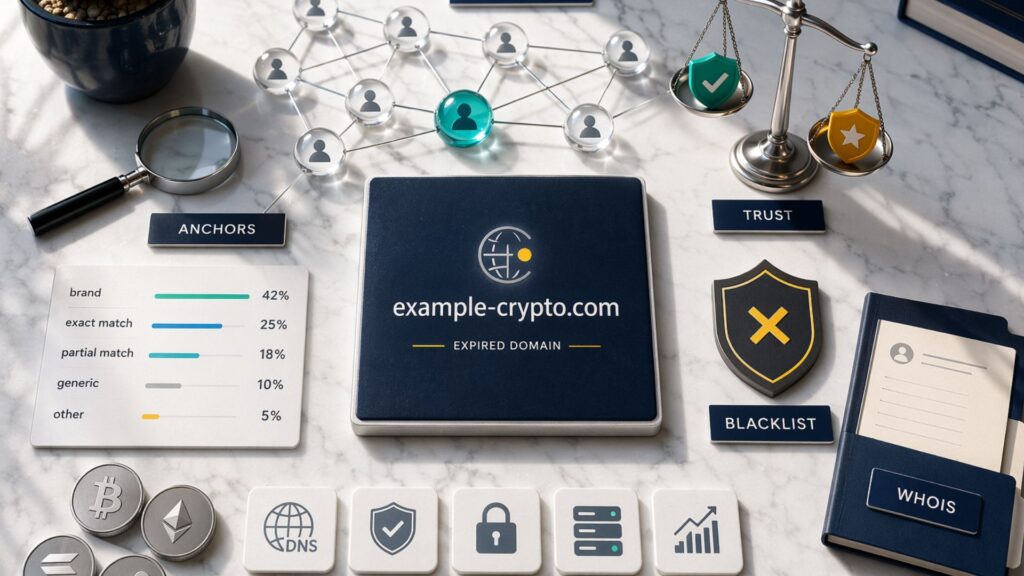
Examine the backlink profile for signs of manipulation or spam. Links from gambling, adult, pharmaceutical, or other unrelated websites, along with obvious private blog networks (PBNs), sitewide links, or sudden spikes in backlinks, can indicate previous abuse. While a few questionable links are common, a backlink profile dominated by these patterns should be treated as a significant warning sign.
Review the Anchor Text Distribution
Anchor text can reveal how a domain earned its backlinks over time. A healthy profile typically includes a mix of branded terms, URLs, and generic phrases, with keywords appearing naturally rather than dominating the profile. This balanced distribution suggests the backlinks were acquired through genuine mentions instead of aggressive link-building tactics.
Review the anchor text for patterns that may indicate previous abuse. Repeated commercial keywords, unrelated foreign-language anchors, or anchors associated with gambling, adult content, pharmaceuticals, or other spam topics are common warning signs. While a few unusual anchors are not uncommon, a profile heavily dominated by these patterns should be considered a potential risk.
Evaluate Domain Trust Signals
Trust Flow and Citation Flow can help you assess the quality of a domain’s backlink profile. Ideally, Trust Flow should be reasonably close to Citation Flow, suggesting that the domain’s authority comes from trustworthy backlinks rather than a large volume of low-quality links. A significant gap between the two may indicate that the backlink profile deserves closer inspection.
Domain Authority and similar SEO metrics can provide additional context, but they should never be the deciding factor when evaluating an expired crypto domain. Use these scores to support your analysis alongside the domain’s history, backlink profile, anchor text, and indexing status, rather than relying on them in isolation.
Look for Additional Risk Factors
Check Ownership History
Review the domain’s WHOIS history to see how often ownership has changed. While ownership changes are normal for expired domains, frequent transfers over a short period may indicate repeated buying and selling, abandoned projects, or previous attempts to repurpose the domain for short-term SEO gains.
Check for Malware, Phishing, and Blacklist History
Look for any history of malware, phishing, or blacklist reports associated with the domain. A domain previously involved in malicious activity may require additional cleanup and could take longer to rebuild trust with search engines and users.
Verify Topical Relevance
Consider whether the domain’s historical content aligns with your intended crypto or blockchain project. A domain with a consistent history in the same or a closely related niche is generally a stronger choice than one that has repeatedly shifted between unrelated topics, as topical consistency helps preserve the relevance of its existing authority and backlinks.
Decide Whether the Domain Is Worth Buying
After completing the previous checks, evaluate the domain as a whole rather than relying on a single metric or warning sign. An expired crypto domain with a consistent history, relevant backlinks, natural anchor text, and no evidence of spam or malicious activity is generally a stronger investment than one with conflicting signals.
Before making a purchase, confirm that the domain:
- Has a clean and consistent historical record
- Is free from obvious spam or phishing activity
- Has high-quality, relevant backlinks
- Shows a natural anchor text distribution
- Doesn’t rely solely on inflated SEO metrics
- Aligns with your intended crypto or blockchain project
If several major warning signs appear during your review, it’s often better to move on and evaluate another domain. Spending more time finding a higher-quality expired crypto domain is usually a better investment than trying to recover one with a problematic history.
Conclusion
Running a full spam check is one of the most important steps before buying an expired crypto domain. Instead of relying on a single SEO metric, evaluate the domain’s history, backlink profile, anchor text, indexing status, and other trust signals to understand its overall quality. Taking a few extra minutes to complete these checks can help you avoid costly mistakes and invest in an expired crypto domain with stronger long-term SEO potential.